Fleet Optimisation

Manage every IT asset according to its usage, value and lifecycle: retain, optimise, resell or renew at the right moment.

An IT fleet is constantly evolving: new business needs, organisational change, budget constraints and environmental requirements. Without the right management approach, it can quickly become fragmented, generate unnecessary costs and lose part of its economic value. 

Econocom’s IT fleet optimisation offer provides a complete view of existing assets, analyses how well they match real needs and defines an optimised trajectory for each piece of equipment. 

Based on an audit combining technical data, usage patterns, equipment condition, lifecycle and residual value, Econocom identifies the best scenario for each asset:

  • Continued use where the equipment still meets business needs;
  • Financial optimisation to better manage investment and anticipate renewals;
  • Buyback and resale of equipment with economic and environmental potential;
  • Renewal towards as-a-service models incorporating full lifecycle management. 

A holistic approach that turns the IT fleet into an actively managed asset over time, combining operational performance, cost control and a contribution to responsible digital objectives. 

  • A consolidated view of the IT fleet: asset inventory, usage analysis, equipment condition and identification of optimisation levers
  • Optimised asset lifecycle management: retention, financing, resale, refurbishment or renewal according to the best trajectory
  • End-to-end support from Econocom, from initial analysis through to operational implementation of the actions identified

Fleet optimisation offer

A comprehensive approach to maximising the value of your digital assets and aligning your fleet with your business, financial and environmental priorities

  • Inventory and analysis of the existing fleet

    The process begins with a thorough analysis of the IT fleet: equipment in service, age, condition, usage, associated contracts and lifecycle history. 

    This consolidated view helps identify under-used assets, over-specified equipment, equipment reaching end of life, and gaps between available configurations and users’ real needs. 

    The goal: a reliable basis for making the right decisions on each asset. 

  • Usage analysis and identification of optimisation levers

    Analysing real-world usage makes it possible to assess how well available equipment matches employees’ operational needs. 

    It takes into account user profiles, business usage, applications used, mobility requirements and expected performance levels. 

    On this basis, Econocom defines optimisation opportunities: model rationalisation, configuration adjustments, equipment reallocation, extended lifespan or targeted renewal. 

  • Lifecycle optimisation: retain, finance, resell or renew

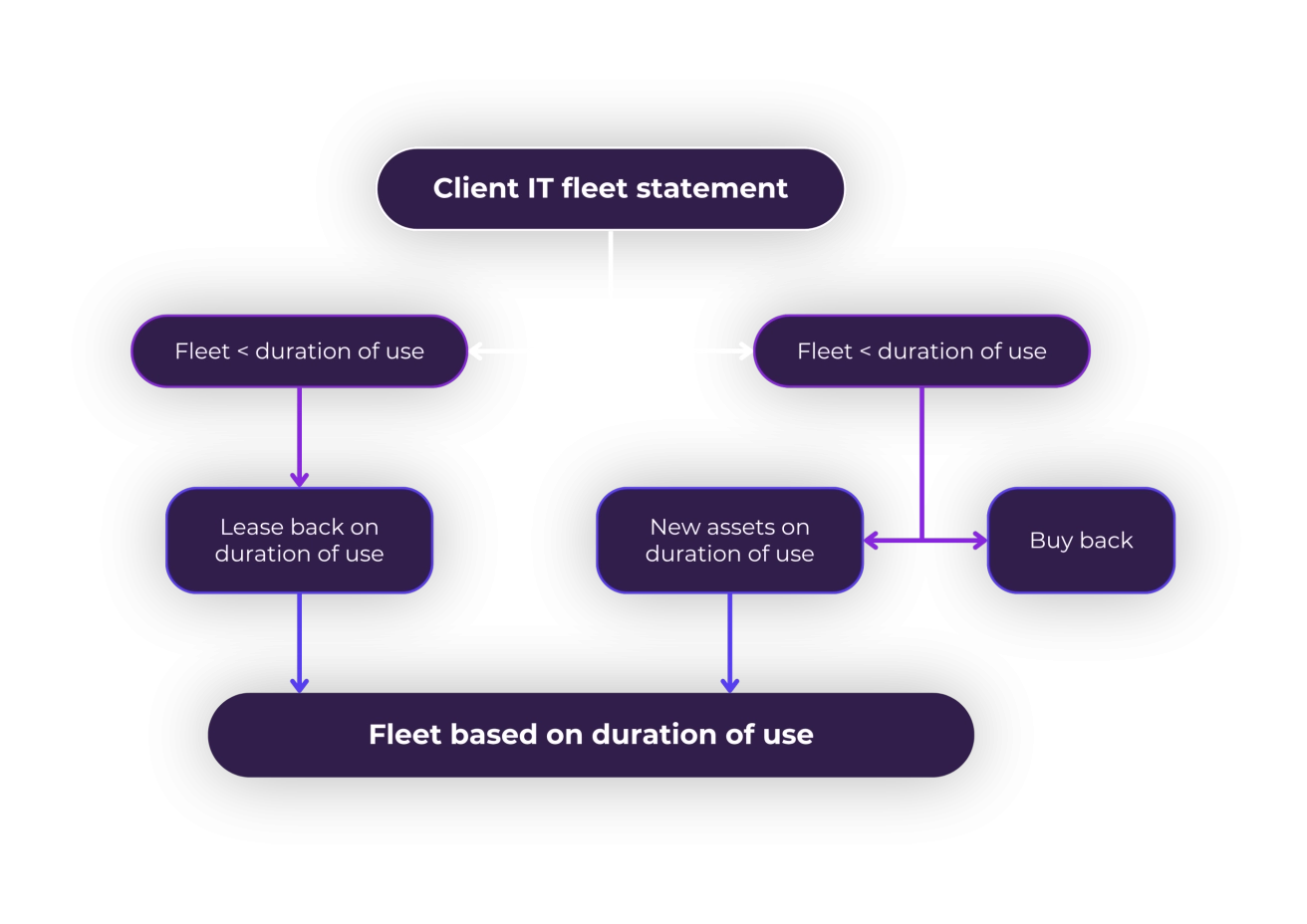
    The aim is not to systematically replace existing equipment, but to apply the most relevant scenario to each asset according to its usage, condition, economic value and environmental impact. 

    Equipment that is still high-performing and suited to business needs remains in use. 

    It can be incorporated into a lifecycle management approach that anticipates renewals, smooths investment and improves budget visibility. 

    Equipment with economic and environmental potential is bought back and resold. 

    After assessment, it can be refurbished and put back into circulation to maximise its residual value while contributing to responsible digital commitments. 

    Equipment that has reached end of use or become unsuitable is renewed with appropriate models. As-a-service solutions can incorporate the supply of new equipment, its operational management, maintenance, monitoring and renewal within a holistic lifecycle approach. 

    This approach ensures that each asset follows the trajectory that creates the most value for the organisation. 

  • Implementation of fleet management tools

    Beyond one-off optimisation, Econocom supports the implementation of proactive IT asset management. 

    Management tools help track how the fleet evolves, anticipate key deadlines, identify future needs and provide reliable indicators to guide investment decisions. 

    The organisation thereby benefits from better control over its digital assets throughout their lifecycle. 

  • Identifying and resolving problems proactively before they escalate

    When a problem is detected, the solution analyses its root cause and automatically proposes or applies the appropriate remediation. This proactive approach significantly reduces mean time to repair (MTTR) and frees support teams from repetitive incidents.

Figures and Evidence

The benefits of optimised IT asset lifecycle management

This approach enabled us to build a tailored trajectory combining cost optimisation, user performance and environmental responsibility.

CIO, multi-site company

A structured 3-step approach to turning your IT fleet into an actively managed asset

  • Asset audit

    Complete analysis of the IT fleet: equipment, configurations, usage, condition, age, lifecycle and potential value.

    Identification of optimisation opportunities:
    - under-used assets;
    - equipment that could have an extended lifespan;
    - equipment with resale potential;
    - renewal needs.

  • Defining the optimisation trajectory

    Building an action plan tailored to each category of asset.

    Depending on the situation:
    - continued use of suitable equipment;
    - financial optimisation and anticipation of renewals;
    - buyback and resale of equipment with potential;
    - renewal towards models incorporating lifecycle management.

    Each recommendation is assessed for its economic, operational and environmental impact.

  • Implementation and ongoing monitoring

    Deployment of the defined actions with IT teams:
    - optimisation of existing equipment;
    - buyback and resale operations;
    - support with renewal;
    - implementation of management tools.

    Econocom monitors the results achieved to embed optimisation as an ongoing process.

An optimised IT fleet, better cost control and maximum value from your digital assets.

  • Reduced total cost of ownership (TCO)

    Fleet optimisation helps identify unnecessary costs, improve the use of existing equipment and better plan future investment.

    Optimised lifecycle management helps sustainably reduce the overall cost of the IT fleet.

  • Better value from existing assets

    Equipment that remains suitable is retained and optimised. Equipment reaching end of use can be bought back, refurbished or resold to maximise its residual value.

    This approach turns an end-of-life cost into an economic opportunity.

  • More agile management of IT change

    With a consolidated view of the fleet and appropriate indicators, IT teams can anticipate renewals, make more secure decisions and support business change more effectively.

  • A concrete contribution to responsible digital practices

    Extending equipment lifespan, along with reuse and refurbishment, limits the environmental impact of digital technology.

    This approach supports organisations' CSR commitments by promoting a circular economy for IT assets.

Frequently Asked Questions

  • Optimisation provides an accurate view of IT assets, their real usage and their potential for change.

    It helps organisations make better decisions: retaining suitable equipment, giving equipment with potential a second life, and renewing only when this creates value.

  • No. The whole point is to identify the best trajectory for each asset.

    Depending on their condition and usage, equipment can be retained, optimised, incorporated into a lifecycle management approach, bought back for refurbishment, or replaced when necessary.

  • An inventory provides a snapshot of the fleet at a given moment.

    Optimisation goes further: it analyses usage, asset value and lifecycle, and defines the actions needed to sustainably improve the fleet's economic, operational and environmental performance.

  • Econocom supports clients across the entire IT asset lifecycle: fleet analysis, trajectory definition, financial optimisation, equipment buyback and resale, renewal and the implementation of new management models.

    Our experts turn an optimisation strategy into concrete, measurable actions.

    Let's talk about identifying the optimisation levers best suited to your fleet.

Speak to an Econocom expert

Optimise your IT fleet in 3 steps with Econocom: audit, action plan and implementation, for equipment adapted to your needs and costs under control.

Discuss your project