
Cloud Migration

Migrate to the cloud with end-to-end support: design, migration and optimisation of a cloud infrastructure suited to your needs

Migrating to the cloud is a defining project that commits the organisation for the long term. Poorly prepared, it generates extra costs, operational disruption and unsuitable architectures. Econocom offers comprehensive support, from initial assessment to post-migration optimisation: choosing the model (private, public or hybrid cloud), designing a resilient, secure architecture, migrating applications and data, then operational maintenance of the environment. A flexible, bespoke approach, focused on project management and cost control. 

  • A flexible approach: private, public or hybrid cloud: the right balance of hybridisation for your needs
  • Bespoke solutions for a scalable, resilient and secure cloud infrastructure from the design stage
  • Support focused on project management and cost control at every stage

Cloud Migration service

From assessment to operational maintenance: comprehensive support throughout the migration journey

  • Implementation: a scalable, resilient and secure cloud infrastructure from the design stage

    Econocom designs and deploys a cloud infrastructure suited to the client’s specific needs: choice of model, component architecture, and integration of security and resilience mechanisms. The aim is an infrastructure that can evolve with the organisation with no major architectural rework. 

  • Adoption: optimising the new cloud infrastructure for applications and data

    The physical migration of applications and data is orchestrated to minimise interruptions. Econocom’s teams support the optimisation of the new environment’s operation: performance configuration, resource adjustment and training IT teams in cloud management. 

  • Operational maintenance: upkeep, security and cost tracking for the cloud

    After migration, Econocom provides operational maintenance of the cloud environment: updates, ongoing security, performance monitoring and tracking of associated costs. This phase ensures the infrastructure remains optimal and cloud spend stays under control over time.

Approach

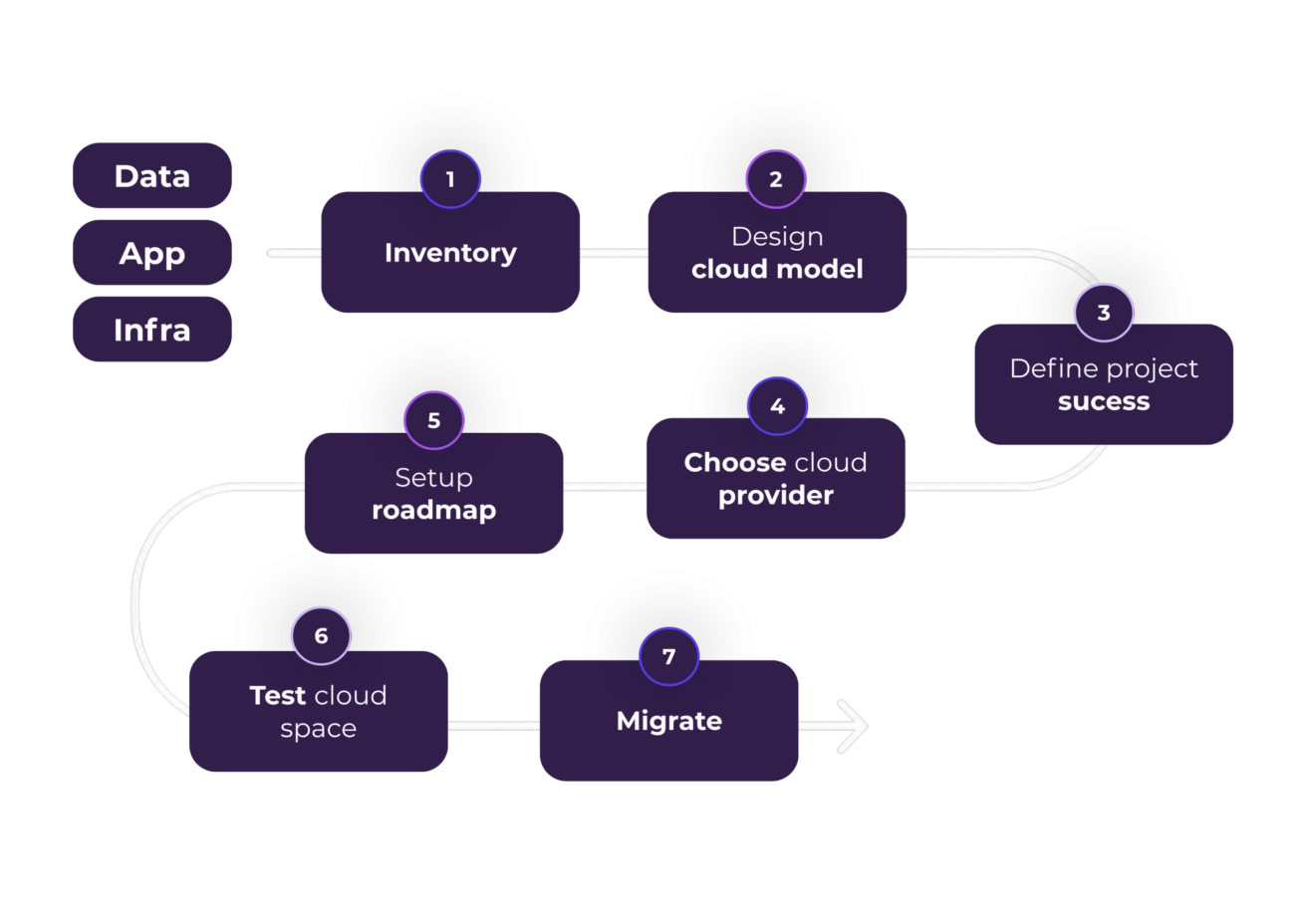
A migration journey structured in stages for a controlled transition

  • Assessment

    Analysis of the existing IT system, mapping of applications and data, identification of migration constraints and assessment of the organisation's cloud maturity. This stage produces the foundations of the migration plan.

  • Planning

    Defining the target cloud model (private, public, hybrid), sequencing the migration waves, identifying risks and drawing up the rollback plan. Costs and timelines are estimated at this stage.

  • Design

    Detailed architecture of the target cloud infrastructure: components, security, resilience, network integration. Econocom's teams produce the technical specifications that guide the migration phase.

  • Migration

    Transfer of applications and data to the new cloud infrastructure according to the plan established. Migrations are carried out in waves to minimise risks and service interruptions.

  • Configuration and optimisation

    Fine-tuning of the cloud environment, optimisation of performance and costs, and implementation of monitoring and governance tools. The environment is adjusted until the expected performance levels are reached.

  • Change management

    Training IT teams in managing the new environment, documenting operational processes and supporting adoption. Change management ensures the organisation makes the most of its new cloud infrastructure.

A cloud infrastructure suited to your needs, controlled costs and enhanced security for your applications.

  • Design suited to the client's needs

    The cloud architecture is built on the basis of an analysis of real needs, rather than a standard model, guaranteeing an infrastructure suited to the organisation's technical, regulatory and operational constraints.

  • Reduced infrastructure and maintenance costs

    Moving to the cloud makes it possible to optimise infrastructure spend: removing the fixed costs associated with on-premise equipment, pay-as-you-go pricing and ongoing optimisation of cloud resources.

  • Enhanced security for the working environment, data and applications

    Econocom's cloud infrastructure builds in security mechanisms from the design stage, encryption, access management, continuous monitoring, to protect data and applications in the new environment.

  • Greater scalability and flexibility

    A well-designed cloud architecture makes it possible to quickly adapt resources to evolving needs, increased capacity, deployment of new applications, geographic expansion, with no delay or over-investment.

Frequently Asked Questions

  • Cloud migration is the process of transferring applications, data and infrastructure from an on-premise environment (or an existing cloud) to a new cloud architecture. It is a strategic decision that commits the organisation for several years: structured support from assessment to optimisation is essential to control costs, risks and timelines.

  • The choice depends on each organisation's specific constraints: data sovereignty, required performance, target costs, latency and regulatory requirements. Econocom takes a flexible, agnostic approach to identify the right balance of hybridisation, with no preference for a particular model or cloud provider.

  • Controlling cloud costs relies on a thorough upfront assessment, an optimised architecture (no over-provisioning), ongoing consumption tracking and post-migration optimisation. Econocom builds cost control in as a constant focus throughout the migration journey.

  • The duration depends on the size and complexity of the IT system, the volume of applications to migrate and the target cloud model. Some targeted migrations can be completed within a few weeks; full migration programmes extend over several months. Let's talk to assess your context.

Speak to an Econocom expert

Plan your cloud migration with Econocom: a flexible approach, a bespoke architecture and end-to-end support: from assessment to operational maintenance.

Discuss your project